Sep, 2026•9 min read • By Michelle, Gravity Projex
A great crowd shot can do more for an event than any ad. Then comes the question: are we actually allowed to post this?
The short answer surprises people. In Australia you can generally photograph and film people in a public place without asking. The rules start to apply when you keep, publish or promote those images. This guide covers what you can and can’t do with photos and video of the public, staff and volunteers at events, with a Queensland focus. Throughout, “photos” includes video and livestreams.
The bottom line
You can take photos and video at a public event and share them on your website and social media, as long as people are told filming is happening and can opt out.
You can’t film in private spaces, use an identifiable person in an ad, testimonial or promotional close up without their consent (and a record of it), feature a child without a parent or guardian’s consent, present anyone as endorsing you, or ignore a request to stop or remove an image.
Translator’s note: taking the photo is rarely the problem. Using it is.
Can you take photos of people in public?
Generally, yes. The Arts Law Centre of Australia says photographing people in public places is generally allowed without permission, and quotes a judge: “a person, in our society, does not have a right not to be photographed.” A few limits still apply.
Places that only feel public. Free entry does not make somewhere a public place. Shopping centres, sports grounds, schools, hospitals, pubs, concert halls and markets are private property, so the operator can set its own photo rules. Where a council gives an organiser control of a public area for an event, the organiser can control photography inside it.
Private moments. In Queensland, section 227A of the Criminal Code makes it an offence to record someone without consent where they would reasonably expect privacy, such as toilets, change rooms or while undressing. Section 227B makes sharing that recording an offence too. Keep cameras out of toilets, change areas, parents’ rooms and first aid spaces.
Sound. Under Queensland’s Invasion of Privacy Act 1971, recording a private conversation you are not part of is an offence. For vox pops and interviews, get the person’s agreement on camera.
Drones. CASA’s rules say stay at least 30 metres from people, never fly over people, and avoid populous areas such as sporting events and concerts. Flying for work needs a CASA licence or accreditation.
Which privacy laws apply to your business?
Three sets of rules can apply. Which ones depend on who you are, not on the photo.
Who you are
Main privacy law
What it means for photos
Businesses and not-for-profits with turnover over $3 million, plus some smaller ones (such as health service providers and businesses that trade in personal information)
Privacy Act 1988 and the Australian Privacy Principles
Identifiable photos are personal information. Notice, use, security and deletion rules apply.
Queensland councils and state agencies, and contractors bound by their agreements
Information Privacy Act 2009 (Qld) and the Queensland Privacy Principles, in force since 1 July 2025
Similar rules, applied to government and the contractors they bind.
Everyone, including small businesses, community groups and individuals
Statutory tort for serious invasions of privacy, since 10 June 2025
People can sue for a serious, intentional or reckless invasion of privacy.
The privacy tort is the one most small businesses miss. Since 10 June 2025, anyone can be sued for a serious invasion of privacy, whatever their size. The person must show they had a reasonable expectation of privacy, that the invasion was intentional or reckless and serious, and that their privacy outweighs other public interests such as freedom of expression. An ordinary crowd shot is unlikely to meet that bar. The risk rises with children, people in distress, and anyone filmed somewhere they reasonably felt unobserved.
Working for a council? Queensland councils must take reasonable steps to bind contractors who handle personal information for them to the Queensland Privacy Principles. If you photograph or film events for a council, check your agreement. You may be bound even as a small business.
Do you need to tell people or ask permission?
These are two different things. Notice tells everyone filming is happening. Consent is a person agreeing to a specific use of their image.
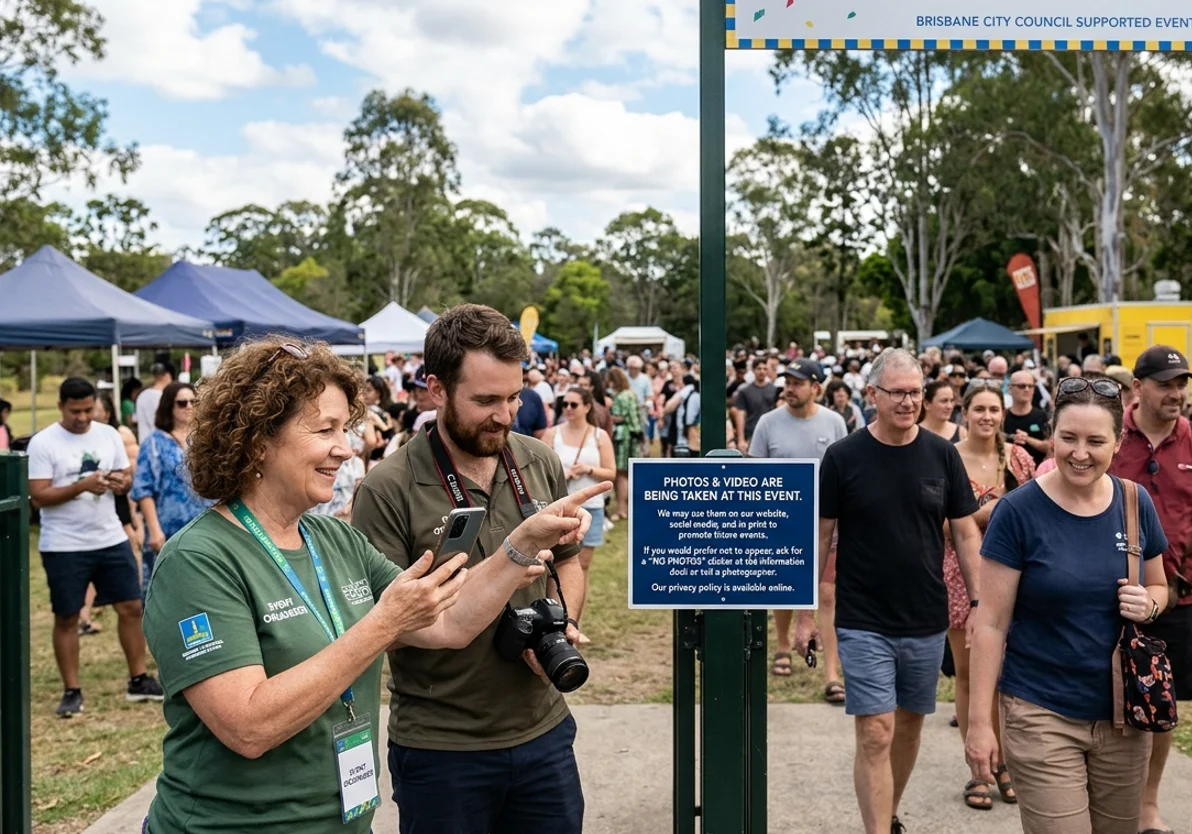
Give notice to everyone. For businesses covered by the Privacy Act, telling people about the collection at or before the time is a legal requirement. For everyone else, it is the cheapest protection you can get. Put it on tickets, registration pages, booking terms and entry signs, and say:
that photos and video are being taken, and by whom
where they will be used (website, social media, print, advertising)
how to avoid being filmed or ask for an image to be removed
where to find your privacy policy
Get consent, and keep a record, before you:
use an identifiable person in a promotional close up
use anyone in a paid ad, boosted post or print ad
pair a photo with a quote, testimonial or name
feature a child (from a parent or guardian)
feature staff, volunteers or stallholders
Translator’s note: a sign at the gate covers the crowd. It doesn’t cover the face on your next Facebook ad.
What can you share on your website and social media?
Australia has no general “image right”, so a lawfully taken photo can often be shared. The risk grows with how identifiable the person is and how promotional the use is.
Implied endorsement. Using someone’s face so it looks like they back your business can breach the Australian Consumer Law, even when the photo was lawfully taken.
Defamation. A caption or context that makes someone look ridiculous can turn a harmless photo into a defamatory one.
Copyright. The photographer usually owns the copyright, not you. Owning the copyright doesn’t give you the person’s consent, and their consent doesn’t give you the copyright. For promotion you often need both.
Situation
Risk
What to do
Wide crowd shot, nobody the focus
Low
Entry notice; keep captions general
Identifiable close up in an organic post
Medium
Ask on the spot and keep a record of the yes
Photo in a paid ad, boosted post or print ad
High
Written consent that names the uses and time period
Photo with a quote, testimonial or name
High
Written consent covering the words and the uses
Attendee’s own photo reposted from social media
Medium
Ask the owner in writing before reposting
Images from a freelancer or volunteer
Medium
Written licence before the event
Identifiable child in any promotion
High
Parent or guardian consent; no full names
Children, staff and volunteers
Children. No Australian law bans photographing children in a public place. Promotion is different. Get a parent or guardian’s consent before using an identifiable child, never publish a child’s full name or school, and skip children who are upset or partly dressed. A child can bring a privacy claim until their 21st birthday, so keep those records longer.
Staff. The Privacy Act’s employee records exemption only covers handling that is directly related to the employment relationship. A staff member’s face in a marketing campaign may fall outside it, so ask first and let staff say no without consequence.
Volunteers and contractors. The employee records exemption doesn’t cover them at all. Add a photo clause to volunteer sign ups and stallholder booking terms, and ask before featuring anyone.
Keeping and removing photos
Store images securely on an access-controlled shared drive, not personal phones or group chats. Tag each image with its consent status.
Delete what you no longer need. Covered businesses must destroy or de-identify personal information once it is no longer needed, and a smaller archive is a smaller risk for everyone.
Keep consent records at least 3 years after an image was last used, and until age 21 for children.
Act quickly on takedown requests. The regulator tells people to ask whoever posted a photo first, so requests will come to you. Remove it from your website, social media and any paid campaigns still running.
Event photo and video checklist
Print this section and take it to your next event.
Before the event ☐ Confirm who owns or controls the venue and whether it has photography rules. ☐ Check whether the Privacy Act applies, whether a council agreement binds you to the Queensland Privacy Principles, and any permit conditions. ☐ Add photo and video notice wording to tickets, registration pages, booking terms and the event web page. ☐ Sign a written licence with every photographer, videographer and volunteer supplying images. ☐ Check any drone operator holds CASA licensing and approvals for the site. ☐ Prepare consent forms (paper or a QR code to an online form), including a parent or guardian version. ☐ Set up an opt out (lanyard, sticker or wristband colour) and brief the team.
On the day ☐ Put entry signs at every entrance and at the information desk. ☐ Brief photographers: no toilets, change areas, parents’ rooms or first aid spaces; no children in distress or partly dressed; respect the opt out. ☐ Ask before close ups that will be used in promotion, and keep a record of the person’s name, contact and what they agreed to. ☐ Record audio only with the speakers’ agreement, and avoid capturing private conversations.
After the event ☐ Move images to a secure shared drive the same day and clear them from personal devices. ☐ Tag images with their consent status before anyone publishes. ☐ Delete rejects and duplicates, and file consent records. ☐ Check captions for names and tone before posting.
Sample notice wording
Copy this onto your own branded sign and place it at every entrance.
Photos and video are being taken at this event. We may use them on our website, social media and in print to promote future events. If you would prefer not to appear, ask for a “no photos” sticker at the information desk or tell a photographer. To have a photo or video removed later, contact us through our website.
And for tickets, registration and booking forms:
Photos and video taken at this event may include you, and we may use them on our website, social media and in print to promote our events. If you would prefer not to appear, let us know before the event or tell a photographer on the day. Our privacy policy explains how we handle your information and how to ask us to remove an image.
What is changing?
The privacy tort is still new, and courts haven’t yet tested where the line sits for event photos. The government also released draft privacy reforms on 31 August 2026, including a proposed “fair and reasonable” test for handling personal information. As at 4 November 2026, that bill hasn’t been introduced to Parliament, and the small business exemption remains in place. We will post an update when it moves.
Common questions
Does consent have to be in writing? No law requires it, and a verbal yes is valid. But if a complaint or claim comes up, you may need to prove it. Keep a record: a form, an email or text, a yes captured on camera, or a note your photographer makes at the time.
Can I post a crowd shot without asking everyone? Usually, yes, if people were told filming was happening and nobody is singled out, embarrassed or shown somewhere private.
Can I photograph children at a public event? Taking the photo is generally lawful. Using an identifiable child to promote your business needs a parent or guardian’s consent, and you should never publish their full name.
Does the Privacy Act apply to my small business? Usually not, if your turnover is $3 million or less, though some small businesses are covered regardless. The privacy tort and the Australian Consumer Law apply to every business, so good habits protect you either way.
What if someone asks me to take a photo down? Remove it promptly from your website, social media and any running ads, and update your records. It is the fastest way to stop a complaint growing.
This article is general information as at November 2026 and is not legal advice. For paid campaigns, children, health settings or a specific complaint, talk to a lawyer.
We use Google Analytics cookies to understand how people use this site, so we can improve it. You can decline and we will stop. Read our Privacy Policy.