Six years out, the work starts now. As Queensland prepares for the 2032 Olympics, tourism and hotel operators must evolve their digital presence to meet the expectations of the next generation of global travellers.
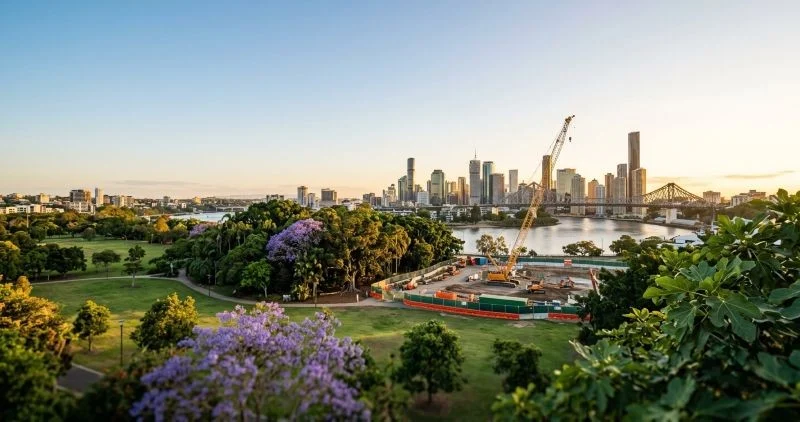
On 1 June 2026, the fences went up at Victoria Park.
That was the day the Games Independent Infrastructure and Coordination Authority took possession of the site and started initial works on Brisbane Stadium: 63,000 seats, roughly $3.8 billion, the venue that will host the opening and closing ceremonies and athletics in 2032. Federal environmental approval had come through the month before. Bulk earthworks are scheduled for late 2026 into early 2027.
For five years, Brisbane 2032 was an argument about venues. It is now a construction site.
That matters for tourism operators for a reason that has nothing to do with the two weeks of sport. The digital assets that will determine who profits from the next six years are the ones being built now, because search authority, review volume and distribution relationships compound slowly. An operator who launches a good website in 2031 has missed it.
Where things actually stand
Worth setting out the facts, because the venue story changed repeatedly between 2021 and 2025 and a lot of operators stopped paying attention.
The Games Delivery Plan landed in March 2025 after a 100 day independent review. The centrepiece is the new stadium at Victoria Park. A 20,000 seat venue is planned at the Brisbane Showgrounds. The Gabba will host cricket during the Games and then be demolished. The Queensland Tennis Centre gains a 3,000 seat showcourt. Sailing goes to the Whitsundays. Early concept designs for the National Aquatic Centre were released in 2026.
Critically for anyone outside Brisbane, events have been deliberately spread. The Sunshine Coast is getting two new grandstands at Sunshine Coast Stadium in Kawana. Moreton Bay is getting a 12 court indoor sport centre at the Moreton Bay Central precinct. This is not a Brisbane-only program, and the accommodation and hospitality demand will not be Brisbane-only either.
The bigger number is not the Olympics
Here is the thing most operators have the wrong way round.
The Games are two weeks. The money is in the twenty years around them, and Queensland has an explicit plan for it called Destination 2045, launched in 2025 with a target of more than doubling visitor expenditure to $84 billion by 2045 and employing 25 per cent more Queenslanders directly in tourism.
The current baseline is not small. Queensland’s visitor economy sits at around $45.5 billion. Tourism supports more than 270,000 jobs and generates roughly $115 million a day in visitor expenditure. About nine in ten tourism operations in this state are small businesses, which is the statistic that should interest you most, because it means the competition for that growth is mostly other small operators rather than global chains.
The early results are running ahead of forecast. International visitors contributed a record $8.2 billion in the year to mid 2026, reported as 17.3 per cent ahead of projections, with China returning as the leading international source market by expenditure at $1.6 billion. The government has committed a record $1 billion over four years, including $446 million in new funding covering an events fund, aviation route development through the Connecting Queensland Fund, and product and capability support.
The phrase being used for all of this is the green and gold runway. It is a useful mental model: 2032 is not the destination, it is the thing at the end of a runway you are already taxiing down.
Why the timing is uncomfortable
The instinct for a small operator is to think about this in 2030. That is too late, for three reasons.
Search authority compounds. A page that has existed for five years, been updated, been linked to and been read outperforms an identical page published last month. You cannot buy the time back.
Reviews are cumulative and slow. An operator with 400 reviews in 2032 got there by collecting two a week from 2026. There is no way to compress that honestly, and Google’s April 2026 policy update tightened the rules considerably on how you can ask.
Distribution relationships take years. Getting listed, getting into the right regional tourism organisation campaigns, getting picked up by trade, getting your data flowing into the right systems. None of it happens in a quarter.
The operators who did well out of Sydney 2000 were not the ones who built a website in 1999.
What to actually do, in order
1. Get your ATDW listing right
The Australian Tourism Data Warehouse is the national content platform that feeds tourism listings out to Tourism and Events Queensland, the regional tourism organisation sites, Australia.com and a long tail of distribution partners.
An enormous number of Queensland operators either have no listing, or have one created years ago with three photos and a description written in a hurry. Because ATDW syndicates, a stale listing is stale in dozens of places at once. It is one of the highest leverage hours available to a tourism business and it costs nothing to maintain.
Fill in every field. Update the images. Keep the availability and pricing bands current. If you run multiple products, list them as separate products rather than one catch-all entry.
2. Fix your Google Business Profile
For most operators this is the front door, not the website. Complete categories, real photos uploaded regularly, correct special hours for Queensland public holidays, and a steady review habit.
Two 2026 changes catch tourism businesses specifically. The Questions and Answers section has been retired, so the FAQ content that used to live on your listing now needs to live on your website where Google and AI systems can extract it. And Google explicitly banned asking customers to mention staff by name in reviews, along with staff review quotas, which was extremely common practice in hospitality.
3. Mark up your site properly
This is the unglamorous technical work that decides whether an AI assistant can recommend you.
Tourism and hospitality have specific schema types that most operators are not using: Hotel and LodgingBusiness for accommodation, TouristAttraction for experiences, FoodEstablishment and Restaurant for food, and Event for anything scheduled. Get the structured data right and your pricing, availability, location and offering become machine readable.
The practical consequence: when a traveller asks an AI assistant to plan four days in the Whitsundays, the businesses that get named are the ones whose information can be read confidently. Being invisible to that process is the modern equivalent of not being in the brochure.
4. Reduce your OTA dependency deliberately
If Booking.com and Expedia are producing most of your bookings, you are renting your customer relationships at fifteen to twenty per cent, and you have no direct line to those guests for the next six years of demand.
The work here is not dramatic. Make sure your direct rate is genuinely competitive and that you are not being undercut on your own inventory. Make your direct booking path faster than the OTA’s, not slower, which is where most operator sites lose. Capture the email address at booking and actually use it. Give people a reason to come direct that is not a two per cent discount.
This is worth auditing properly rather than guessing at, because rate parity leakage is usually invisible until someone goes looking.
5. Take accessibility seriously, because the Paralympics are coming too
This is the gap I would most want to exploit if I ran a Queensland tourism business.
Brisbane hosts the Paralympic Games in 2032. Accessible tourism is a large and underserved market in ordinary years, and Queensland is about to host the world’s largest gathering of people for whom accessibility information is the deciding factor in every booking.
Most tourism websites in this state cannot tell a wheelchair user whether the bathroom door is wide enough, whether there are steps at the entrance, or whether the tour boat has a transfer. That information is either missing or buried in a PDF.
Two layers to this. The website itself should meet WCAG 2.2 Level AA, which under the Disability Discrimination Act is the benchmark used to assess whether a service is accessible. And the content should include specific, honest access information: door widths, step counts, hearing loop availability, quiet times for people with sensory sensitivity, and photographs of the actual access route.
Being the operator who has that information published, six years early, is a genuine competitive position and not a difficult one to take.
6. Get ready for the markets that are actually arriving
China has returned as Queensland’s leading international source market by expenditure. Aviation route development is a funded pillar of Destination 2045, which means new direct routes and new source markets.
Practical implications: proper hreflang implementation if you translate, payment methods beyond Visa and Mastercard, and content that does not assume Australian cultural knowledge. Note that machine-translated pages with no hreflang markup can do more harm than good, so this is worth doing properly or not at all.
7. First Nations content, done as partnership rather than tactic
Demand for authentic cultural tourism is real and growing, and Destination 2045 was shaped with Traditional Owner input.
A note on how to approach this. An earlier version of this article framed First Nations content as an SEO signal that AI search engines look for. That framing was wrong and worth correcting. If you are including Indigenous content on your site, it should be because you have an actual relationship, a permission, or a genuine partnership, and it should be developed with the relevant Traditional Owners. Acknowledging Country is appropriate and welcome. Appropriating cultural material for search performance is neither, and the industry is increasingly able to tell the difference.
Do it properly and it is a strength. Do it as a tactic and it is a reputational liability.
8. Then, and only then, the immersive stuff
Video backgrounds, drone footage, 360 degree room tours. These are genuinely effective when the fundamentals are in place and actively harmful when they are not, because they are heavy and most operators deploy them in a way that destroys mobile load performance.
A traveller on 4G in a hire car does not want your autoplaying hero video. They want to know if you have a room tonight and how much it costs. Get the fast, findable, bookable part right first. Then make it beautiful.
A rough timeline
2026 to 2027. Foundations. ATDW, Google Business Profile, schema, site speed, accessibility, review habit. Boring, cheap, compounding.
2028 to 2030. Build authority. Content that answers real traveller questions, regional partnerships, direct booking growth, email list, multi-market readiness as new air routes land.
2031. Test everything under load. Confirm your booking path holds up, your inventory syncs, your access information is accurate. Do not be making changes in 2032.
2032. Trade.
The honest version
Most Queensland operators will do nothing until 2030, then panic, then pay a premium for rushed work that has no time to mature. That is what happened before Sydney 2000 and it is what is happening now.
The advantage available right now is not clever. It is simply being early, on unglamorous things, while everyone else waits for the stadium to be finished.
The fences are up. That is your starting gun.