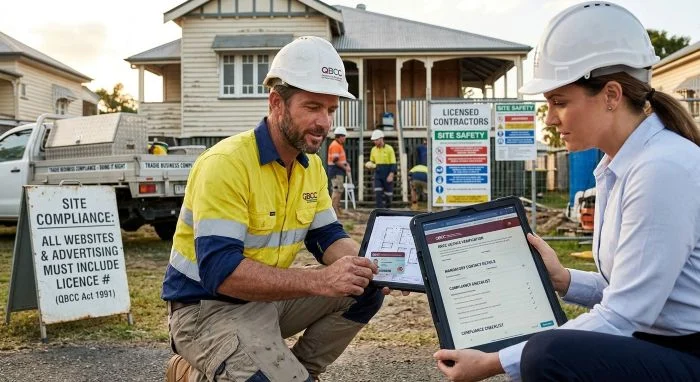
We built a website for a concreting business on Brisbane’s northern side recently. Family-owned, operating since 2008, QBCC licensed, the kind of outfit that gets most of its work through word of mouth and has never needed to think hard about the internet.
Somewhere in the pre-audit, we went looking at what their competitors were doing. Twenty or so trades websites across Brisbane and Moreton Bay (concreters, builders, sparkies, plumbers). The overwhelming majority were breaking a legal requirement that most of them almost certainly don’t know exists.
The bit nobody tells you
In Queensland, if you hold a QBCC licence, your advertising must include the name your licence is registered under and your QBCC licence number. This is set out in the Queensland Building and Construction Commission Act 1991. It isn’t a guideline or a best practice. Failure to comply is an offence under the Act.
The word that trips people up is “advertising”. Most licensees assume it means a newspaper ad or a truck decal. It doesn’t. The QBCC’s own guidance covers any advertising you organise or publish for your business – which in 2026 means your website, your Facebook page, your Instagram profile, your Google Business Profile, your Gumtree listing and your radio spot, alongside the signage on the ute.
Go and look at your homepage now. Is your licence number on it? For most Queensland trades sites, the answer is no. Plenty display a “QBCC Licensed” badge or a line of text and stop there, which is not the same thing and does not satisfy the requirement.
Three related traps worth knowing:
Don’t use the QBCC logo. The QBCC is explicit that its logo cannot be used on your own promotional material at all. Doing so is a breach of the Copyright Act 1968 and can be pursued legally. A surprising number of trades websites carry it, usually added in good faith by a designer who thought it looked reassuring. Remove it. Write “QBCC Licence No. 12345678” as text instead, it’s more useful to the customer anyway, because they can check it.
Match the name exactly. The business name in your advertising must match the name the licence is registered under. If you trade as something different, the licence details still need to appear.
If you’re not licensed, you have to say so. Unlicensed people advertising building work must state the value limitation in the ad which for general building work, that’s the $3,300 threshold. Advertising to carry out licensable building work without the licence to do it is itself an offence.
Here’s the part that should interest you commercially rather than legally. Your customers have been told, repeatedly, by the QBCC itself, that missing licence details in an advertisement is a warning sign of an unlicensed operator. The regulator actively tells homeowners that if the ad doesn’t show these details, there’s a chance the tradie isn’t licensed.
So the licence number isn’t a compliance chore. It’s a trust signal your competitors are leaving on the table, and one your customers have been explicitly trained to look for.
What a trades website actually needs
Now the practical part. Trades websites fail in a fairly predictable set of ways, and almost none of the failures are about how it looks.
1. The phone number is the product
For a trades business, the website’s job is overwhelmingly to produce a phone call. Not a newsletter signup, not a brochure download, not “engagement”.
That means the number appears in the header on every page, tappable, as an actual tel: link. It appears again in the hero section. It appears in the footer. And it is written large enough to be read by someone in their fifties standing in a driveway with the sun on their screen.
We see beautiful trades websites where the phone number is a small grey line in the top corner, unlinked, so tapping it does nothing. That single mistake costs more leads than every other design decision combined.
2. Service areas named as actual suburbs
“We service Brisbane and surrounds” is invisible to search. Nobody types “and surrounds”.
People search “concreter Narangba”, “electrician Caloundra”, “plumber North Lakes”. If those suburb names appear nowhere on your site, you have no chance of matching those searches and increasingly, no chance of being surfaced when someone asks an AI assistant for a recommendation in a specific area.
There is a right way and a wrong way to do this.
The wrong way is generating forty near-identical suburb pages with the place name swapped out. Google has been penalising thin doorway pages for years and has got better at spotting them, not worse. It’s a tactic that used to work, still gets sold by cheap SEO outfits, and now actively hurts.
The right way is a genuine service area section listing the suburbs you actually work in, plus a small number of substantial pages for the areas that matter most to you with real content about that area. What the soil is like in that pocket. The council’s requirements. Jobs you’ve completed there, with photos. That’s a page worth ranking, and it’s a page an AI can quote from.
3. Real photos of real jobs
Trades is one of the few industries where the customer genuinely wants to see the work, and one of the few where stock photography is instantly detectable.
A gallery of twenty photos taken on your phone at actual jobs will outperform professionally shot generic concrete every time. Before and after pairs are better still. Add the suburb to each image’s alt text and file name – you get accessibility, SEO and honesty from the same thirty seconds of work.
If you’ve been sending job photos to your customers via text for years, you already have the asset. It’s sitting in your camera roll.
4. Evidence, not adjectives
Every trades website says “quality workmanship” and “competitive pricing” and “no job too big or small”. These phrases have been used so universally that they now carry precisely zero information.
Replace them with things that can be verified. Years in operation with the actual year. Licence number. Insurance status. Number of jobs completed. Named service areas. Real reviews with real names, not “Happy Customer, Brisbane”.
One specific note on testimonials: if you’re displaying Google reviews, they need to be real and attributable. And be aware that Google’s April 2026 policy update explicitly banned asking customers to mention a staff member’s name in a review, along with setting review quotas for your team. If your process involves either, change it as enforcement is automated now.
5. A quote form with four fields, not fourteen
The quote request is where trades websites bleed. We regularly see forms asking for name, email, phone, address, suburb, postcode, preferred contact method, project type, project size, budget range, timeframe, how you heard about us, and a message.
Nobody standing in their backyard on a Saturday morning is filling that in.
Four fields: name, phone, suburb, and what they need. Optionally a photo upload, which for trades is genuinely useful and a picture of the cracked driveway tells you more than three paragraphs would. Everything else you can ask on the phone, which is where the conversation should be happening anyway.
And test it. Send yourself a test enquiry today. A meaningful proportion of the trades websites we audit have contact forms that have been silently failing for months, usually because a hosting change broke the mail function and nobody noticed the enquiries had stopped.
6. It has to work on 4G in a driveway
Your customer is not browsing on a fibre connection at a desk. They’re on a phone, possibly on patchy reception, often standing outside looking at the problem they want fixed.
A site loaded with a page builder, five plugins for effects, an uncompressed hero video and a 4MB header image will take eight seconds to become usable in those conditions. Most people won’t wait, and the ones who do are already annoyed.
This is the practical argument for lightweight, custom-built sites over builder-generated ones. It isn’t purism, it’s that a trades website has one job, and speed is a substantial part of doing that job.
What doesn’t matter as much as you’ve been told
A blog. For most trades businesses, a weekly blog is a poor use of time. Your search visibility comes from your Google Business Profile, your service pages, your suburb content and your reviews. If you have the appetite for content, a handful of genuinely useful pages; what a concrete driveway actually costs in Brisbane, how long before you can drive on it, what to ask before you hire anyone will do more than fifty short posts.
Animation and scroll effects. They cost load speed and add nothing to a decision that’s being made on trust and price.
A long “About Us”. Two paragraphs and a photo of the actual person who’ll turn up. Nobody is reading your company values.
Being on every platform. For most Queensland trades, Facebook and Google carry the load. Instagram is worth it if your work is visual; concreting, landscaping, tiling, carpentry all photograph well. LinkedIn is worth it only if you’re chasing commercial or builder work rather than residential.
The order to do it in
If you’re starting from nothing or rebuilding:
Get the QBCC licence details onto every page first; it’s a legal requirement and takes ten minutes. Then fix the phone number so it’s prominent and tappable everywhere. Then get your Google Business Profile properly sorted, because for a trades business that listing is doing more work than the website is. Then real job photos. Then honest service area content. Then, and only then, worry about how it looks.
We build custom websites for Queensland trades businesses. No page builders, no templates, no monthly lock-in. See our work or start a project.
Disclaimer: This article outlines general advertising obligations under the QBCC Act as published by the QBCC. It isn’t legal advice. Check the current requirements at qbcc.qld.gov.au or speak to the QBCC directly about your specific licence class.