You might remember seeing it reported on SmartCompany: staff at Noosa Council paid more than $2 million into a fraudulent account in 2024, after scammers impersonated a contractor and convinced them to update payment details. Close to home, and to an organisation with far more process and oversight than most small businesses will ever have.
It’s not just a local story. That same year, engineering giant Arup confirmed that an employee joined what he believed was a video call with his CFO and several colleagues, and authorised transfers worth the equivalent of AU$25.6 million. Every person on that call was an AI-generated deepfake: voice, face, mannerisms, all synthetic.
One council, one multinational, two continents, the same playbook. That’s the reality of cyber security in 2026. It’s not an IT problem anymore. It’s a business problem, and it’s landing on ordinary desks every single day.
We’re not here to scare you into buying something. We’re here to make this make sense, the same way we do with every other part of your digital world. So let’s break down what’s actually happening, why small businesses are in the firing line, and what genuinely moves the needle.
The numbers, plainly
A 2026 small business cyber security survey found 84% of Australian small businesses had experienced a cyber incident in the past year, up three percentage points from the first round of research in 2023. This isn’t rare bad luck. It’s the norm.
The Australian Signals Directorate’s Annual Cyber Threat Report backs this up. More than 84,700 cybercrime reports were lodged in the 2024–25 financial year, an average of one report every six minutes, with the average self-reported cost per report climbing to $80,850. And 2026 has seen a clear shift from broad, opportunistic attacks toward assaults aimed specifically at small and medium businesses, not the scattergun spam of a few years ago.
Attackers target small businesses for one simple reason: they’re prime targets precisely because they often lack the protection larger organisations have in place. No malice needed on your part, no mistake required, just the assumption that you’re an easier door to open.
And here’s the part that should really land: the Cyber Wardens Small Business Pulse Check Report 2026 found that most small business owners don’t believe they could financially recover from a serious attack at all. Not “it would hurt.” Not “it would set us back.” Recover. For a lot of small operators, one bad incident isn’t a bump in the road. It’s the end of the business.
What’s actually changed in 2026
The tools have changed more than the tactics. Phishing, invoice fraud and impersonation aren’t new. What’s new is how convincing they’ve become.
AI has removed the tell-tale signs. The obvious spelling mistakes and clunky phrasing that used to give a scam email away are gone. Phishing has evolved into what’s being called “AI-Phishing 2.0”: messages with perfect grammar, built using deepfake technology to impersonate trusted vendors or company directors. Your team can no longer rely on gut feel to spot something off.
Voice and video impersonation is now a real, working attack. This is the part that catches people out. AI deepfake use in business email compromise jumped from under 5% in 2023 to 40% by early 2026, driven by cheaper tools and rising success rates. The Arup case above wasn’t a one-off, and it only takes a few seconds of someone’s voice, lifted from a podcast, webinar or LinkedIn video, to build a convincing clone.
Business email compromise is expensive and getting worse. In Australia specifically, BEC attacks increased by 7% year-on-year, slightly above the global average. It usually starts small: an invoice, a “quick favour” from the boss, an urgent payment change, and ends with a wire transfer that can’t be undone.
Ransomware hasn’t gone anywhere, and it’s nastier now. Attackers don’t just lock your files anymore; many use double extortion, stealing your data before encrypting it so they have leverage even if you can restore from backup.
Your suppliers are now part of your risk. Because modern businesses rely on networks of vendors and partners, attackers increasingly target a weaker link in that chain, like a small IT vendor, a booking platform, or a plugin developer, to reach a bigger, more valuable target downstream. Picture a small web hosting provider or software vendor getting compromised, and every one of their clients inheriting that exposure without ever being attacked directly. If you use cloud software, plugins, or an external IT provider, their security posture is now part of yours, whether you’ve thought about it that way or not.
QR codes and phone calls are the new front door. Multi-factor authentication is still one of the best defences available, which is exactly why attackers have stopped trying to go through it and started going around it. A “quishing” attack hides a malicious link inside a QR code, on a poster, an invoice, or a fake parking fine, because phones scan them without the usual scrutiny a link in an email gets. Vishing, the phone-call version, has attackers ringing staff directly, posing as IT support, a bank, or even a government department, to talk someone into handing over a code or resetting a password live on the call. Neither needs a single line of malware to work. They just need someone in a hurry.
Why “we’re too small to be a target” doesn’t hold up
It’s tempting to think cybercriminals only chase big companies with big payouts. The opposite is true. Attackers now run these scams like a business themselves: automated, scaled, and relentless. A small operation with one bookkeeper and no dedicated IT team isn’t beneath their notice. It’s exactly what they’re looking for.
And the fallout isn’t just financial. Australian insurers are increasingly refusing cover, or charging much higher premiums, to businesses that can’t demonstrate baseline security standards, meaning weak cyber hygiene can now cost you before an attack even happens. Cyber insurance applications in 2026 routinely ask about MFA, backup practices, and staff training before they’ll even quote you, and a “no” to the basics can mean a declined policy rather than just a higher premium.
Then there’s the compliance side. The Notifiable Data Breaches scheme, run by the Office of the Australian Information Commissioner, currently applies mainly to organisations with annual turnover over $3 million, plus a handful of small businesses handling specific data types like tax file numbers. If that’s not you yet, don’t get too comfortable. Removing the small business exemption is already on the table as part of the next round of privacy law reform. And regardless of which side of that line you sit on, a serious breach involving customer data is a reputational hit either way. Recent enforcement action has seen penalties reach into the millions for organisations that mishandled a breach, on top of the cost of the breach itself.
What actually works: no jargon, no scare tactics
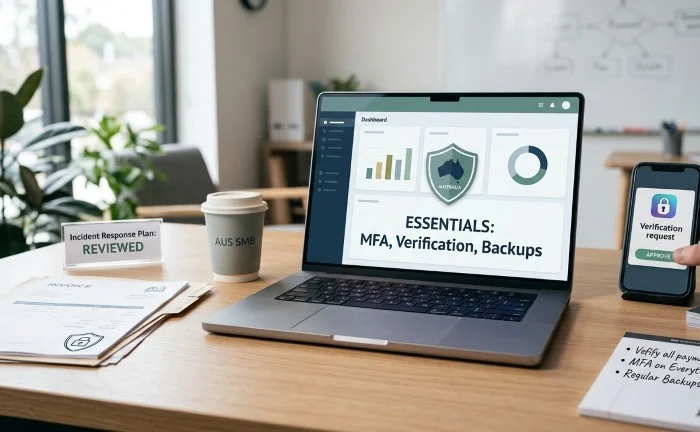
You don’t need an enterprise security budget to materially reduce your risk. You need the fundamentals, done properly and consistently.
- Multi-factor authentication on everything that matters: email, accounting software, cloud storage, banking. It’s still one of the single most effective protections available, and it’s usually free.
- A password manager, and no reused passwords. If one login gets caught in a breach somewhere else on the internet, it shouldn’t be the same password protecting your business email.
- A verification step for any payment change or urgent transfer request: a phone call to a known number, not a reply to the email or a callback to the number provided in the message itself. This one habit would have stopped almost every case above.
- Backups that are offsite, automatic, and actually tested. A backup you’ve never tried to restore from isn’t a backup. It’s a hope.
- Software and devices set to update automatically. Outdated apps are one of the most common ways attackers get in, and it costs nothing to fix.
- Access limited to what people actually need. Not everyone needs admin rights, and former staff or contractors shouldn’t still have active logins months after they’ve left.
- Basic staff awareness, revisited regularly. Not a once-a-year slideshow, but short, real-world refreshers on what today’s scams actually look like, since the old advice about spotting typos no longer applies.
- A simple incident response plan. Who do you call, what do you shut down first, who tells your clients: decided in advance, not in a panic.
- A genuine look at your suppliers and IT provider. Ask what they cover, what they don’t, and where the gaps sit. Don’t assume it’s handled just because someone else is technically responsible for it.
None of this requires a chief security officer or a six-figure budget. It requires consistency, and someone keeping an eye on it who isn’t too buried in the rest of the business to notice.
Where this is heading
Cyber security in 2026 isn’t a box you tick once. It’s an ongoing part of running a digital business, the same as your website, your marketing, or your books. The tools attackers use will keep getting smarter, and that part isn’t going to slow down. But the fundamentals that stop most of it haven’t changed nearly as fast, and they’re well within reach of a business with no dedicated IT team and no six-figure budget.
The businesses that come through this decade intact won’t necessarily be the ones with the biggest security spend. They’ll be the ones that treated the basics as routine maintenance, checked regularly, owned by someone, never assumed to be “sorted”, rather than a crisis they’ll deal with if it ever happens.